Go directly to content

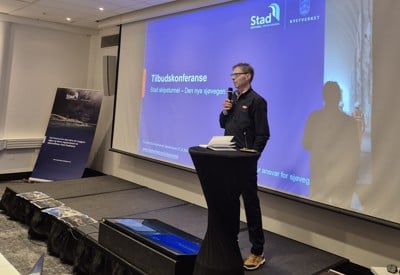
Information for potential contractors for the Stad ship tunnel

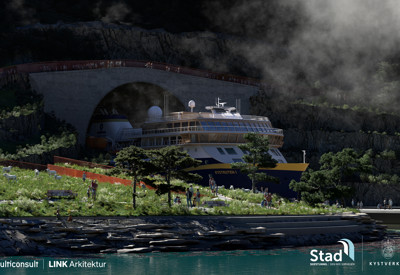
Photo:Kystverket/Snøhetta/Plomp

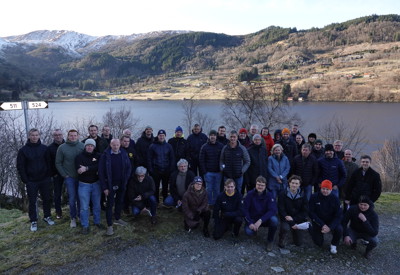
Three contractors submitted final bids for the construction of the Stad Ship Tunnel on April 16.

Following a prequalification phase, three contractors/bidders submitted initial bids on 10 June 2025.

The three bidders who submitted offers and remain in the competition are:

  • Joint venture: Skanska Norge AS and Vassbakk og Stol AS (Norway)
  • AF Gruppen Norge AS (Norway)
  • Eiffage Génie Civil (France)

The final bids are now being evaluated. The tender has been issued subject to financing. If the Stortinget approves a new sufficient cost framework, the aim is to sign the contract within the bid validity period, which is set to 31 August 2026.

This could allow construction to begin in early 2027.


Local Subcontractors and Site Facilities

A dedicated supplier list has been created, providing an overview of suppliers and contractors from Nordfjord to Søre Sunnmøre, with a special focus on businesses in the Stad, Vanylven, and Kinn municipalities. The list includes 28 industries and approximately 200 companies. It also contains proposed site facility locations near the ship tunnel.

For Suppliers – Contact the Contractors

If you have solutions, products, services, or personnel relevant to the project, we encourage you to reach out directly to one of the main contractors participating in the competition.


The Stad Ship tunnel project

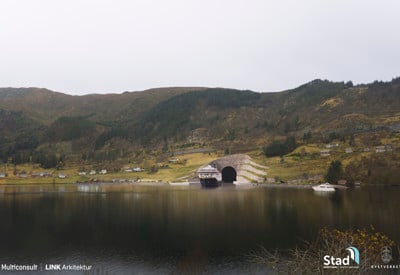
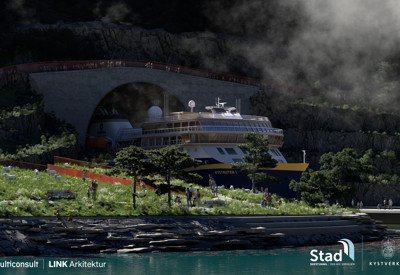
Stadhavet Sea is the most exposed and treacherous stretch of water along the Norwegian coast. The goal of the project is to ensure a safer passage through Stad.

KEY FIGURES

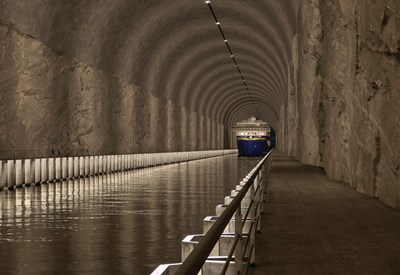
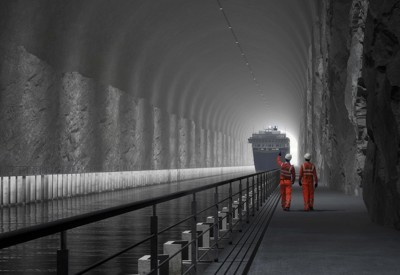
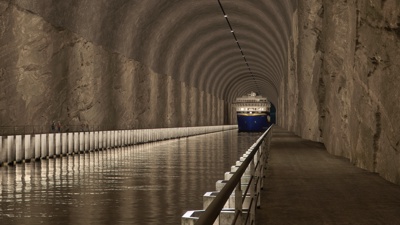
  • Length: 1700 metres for the tunnel run. 2200 metres from the tip of the lead construction to the tip at the other side. 
  • Height from base to ceiling: 50 metres
  • Width between the walls of the tunnel: 36 metres
  • Height from sea surface to ceiling: 33 metres
  • Cross-sectional area: 1661 m²
  • Volume of rock to be removed: Approx. 3 million m³. Equal to approx. 5,4 million m³ of blasted rock – which is equal to approx. 750 000 lorry loads.
  • Estimated cost of construction: Approx. NOK 5,04 billion (2024, including VAT)
  • Estimated construction time: Approx. 5 years

CONSTRUCTION

Conventional blasting, with tunnel drilling rigs and bench rigs, is planned.

Three different alternatives for the use of rock masses from the tunnel construction are being investigated, including the establishment of a new commercial area locally.

THE PROJECT

  • The Norwegian Coastal Administration devised a concept study (KVU 2010) covering the following alternatives: ‘The zero alternative’ (with no new measures), ‘Small tunnel’ and ‘Big tunnel’.
  • A quality assurance process (KS1 report) has also been carried out for KVU 2010, commissioned by the Ministry of Trade, Industry and Fisheries and the Ministry of Finance.
  • In the National Transport Plan 2014-2023, the Government said that they wanted to proceed with a preliminary project for KS2, based on the ‘Big tunnel’ alternative. This was considered to have greater potential benefits.
  • Positive effects, such as the value of moving traffic from road to sea, safety and increased tourism, as well as positive effects for the fishing industry and other industries have not been calculated.
  • Stad ship tunnel will be the world’s first full-scale ship tunnel of this size.
  • In 2017 Norconsult AS and Dr. Techn. Olav Olsen AS delivered a technical preliminary project for the ship tunnel. The report includeed the topics lead structures, entrance structures, road bridges, portals, excavation and embankment, sailing through the tunnel, roads, electrical and telecommunications installations, fire and risk, ventilation, landscape designs and the environment
  • In the National Transport Plan 2018-2029, the Stad ship tunnel was included with a cost framework of NOK 2.7 billion. NOK 1.5 billion is included in the first part of the National Transport Plan, for the period 2018 to 2023.
  • The Norwegian Coastal Administration delivered its preliminary project to the Ministry of Transport in the spring of 2017. The project has been through external quality assurance phase 2 (KS2).
  • The Norwegian Coastal Administration carried out a project optimisation, with delivery on 15 June 2019, which resulted in a significant cost reduction.
  • In 2020, an extended quality assurance process (KS2) was carried out on the results of the project optimisation.
  • In February 2021, the Norwegian Coastal Administration received the letter of commission from the Ministry of Transport, which gave the green light to start preparations for construction. In March, the Ministry presented the proposition to the Storting on construction

Recent news articles about the project

Go to top